
The Mystery of Maria Jane Dukelow
[Published March 29, 2011] [Updated March 30, 2011]


There has always been somewhat of a puzzle over the exact number of children born to our ancestral grandparents, Thomas and Elizabeth Ducklow / Dukelow.  The number has appeared to 13 by accounts of from many different sources.  But there has be a bit of lingering doubt if this number should be 14 due to a mysterious baptismal record for a baby named Maria Jane Dukelow -- whose parents were Thomas and Elizabeth Dukelow.  This record of baptism is from St. Paul’s Episcopal church, the same church were Thomas and Elizabeth and family were very active members. Despite the name being linked to Thomas and Elizabeth, this record seemed spurious, as no other references to Maria Jane have been discovered.  It also puts the child count beyond 13 which conflicts with other reliable information on the children of the family.   The name Maria Jane Dukelow is only known to be documented by this one church record. It has been tempting to disregard the record, but the source is so authoritative that to do so would be a compromise of research integrity. So this one record of Thomas and Elizabeth's Maria Jane has remained a mystery.


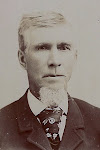
Left: Elizabeth Ducklow Hanson and John Hanson. Circa 1922.  Picture from the Ruth Sandmann Photo Collection. Elizabeth is about age 66 here.


Examining the records again today, I think I have unknotted the issue.  

The ninth child of Thomas and Elizabeth Ducklow was Elizabeth Ducklow born on October 10, 1856. This Elizabeth grew into adulthood and went on to marry John Hanson.  Together, John and Elizabeth farmed and raised their family of eight children near Poskin in Barron County, Wisconsin.  It seems very straightforward to concluded that the Elizabeth Ducklow Hanson was named after her mother, Elizabeth Nicholson Ducklow. This reasoning is logical and traditional, but now appears to be not quite accurate. I believe that Elizabeth Ducklow Hanson was originally named Maria Jane Ducklow.

Why would her name change? How did Maria Jane become to be known as Elizabeth?

Maria Jane had a slightly older sister named Elizabeth.  About four months after Maria Jane’s birth, older sister Elizabeth died in February of 1857. Elizabeth was about 18 months old.  In the grief of losing a loved baby, the family decided to rename four-month old Maria Jane to honor baby Elizabeth.  Naming a new baby after a sibling who died as an infant was quite common during this period.  In fact Thomas and Elizabeth had done this once before when infant son George died and they named their next son George (see footnote).  No doubt the short gap in age (maybe 14 months) between the first Elizabeth and re-named Maria Jane blurred the line of identity of the two infants and eased the grieving process. So Maria Jane became Elizabeth. What seems to be unique about this case is that is s a re-naming of a several-weeks-old baby after its sibling died in contrast to the naming a new-born.

While there is not absolute proof that this name change occurred, the known facts support the argument well.  Here are five reasons why I believe this to be true:

(1) There is a baptism record for a Maria Jane Dukelow born to Thomas and Elizabeth Dukelow (not Ducklow – see footnote) recorded in the St. Paul Episcopal church records.

(2) Beyond this one baptism record, there is no further mention of a Maria Jane in other known records for Thomas and Elizabeth’s family, including a Federal Census taken in 1860.

(3) No baptism record can be located for the second baby Elizabeth born to Thomas and Elizabeth.  However all of Thomas and Elizabeth's other children that were born in Wisconsin have baptism records at St. Pauls, including the first baby Elizabeth baptized 11 November 1855.

(4) The baptism date of Maria Jane is Nov 9, 1856.  Second baby Elizabeth's birthday is October 10th 1856, a one-month period typical of the time elapse between a birth and baptism.

(5) The obituary for Thomas Ducklow (Sr.) states that he and Elizabeth had 13 children. Accounting for Maria Jane would require 14 children.  By recognizing the Maria Jane and second baby Elizabeth are the same person restores the count to 13.

You may wonder that when Thomas and Elizabeth changed Maria Jane's name to Elizabeth did they have to change Maria Jane’s birth certificate?  The short answer is no.  Recall that Wisconsin became a state in 1848 and had very a limited government regulation in 1856.  It was not until 1907 that the state required births to be registered. So in this case there was no birth certificate to be concerned with.  The lack of red tape meant there was no real barrier to renaming a child, especially a child that was only four months old.  It was simply a matter of calling the baby a new name.  The church may have frowned a bit on this, but no doubt there are many other examples of children being baptized with one name, but called by something completely different in day-to-day life.

So with this explanation, the mystery of the name Maria Jane Dukelow / Ducklow is solved. Elizabeth Ducklow Hanson was actually, at least according to St. Paul's church’s records, Maria Jane Ducklow Hanson.

 ❧

Footnotes:

(1) Elizabeth’s older brother, George was the second George of the family.  Infant George was born September 1849 and died October 14, 1850.  The next child born to Thomas and Elizabeth was also named George.  He was born 10 August 1851.


(2) As documented elsewhere in this blog, the spelling of the surname Ducklow took several forms, especially before the 1860s.  Dukelow was a common spelling, and was used by several of Thomas’ half-brothers. It is possible that another Thomas Dukelow lived in the Ashippun area and had a child named Maria Jane and attended church at St. Paul’s Episcopal Church.  While possible, it seems unlikely. 

(3) Of all the records viewed, Elizabeth Ducklow Hanson name never appears with a middle name.  A possible future discovery of her middle name of being Maria or Jane or Maria Jane would certainly add  credibility to this story.


(4) In a bit of ironic near miss of overlapping names, my wife's name is Jane Marie Ducklow.

❧
The Joy of a Sugar Bush
And the Price of Maple Syrup in 1918 and 2011
[Published February 26, 2011]

In a few short weeks maple syrup making season begins.  Near Spring Valley the season normally starts shortly after St. Patrick’s Day and runs until the first or second week of April.  I love maple syrup season as it signals spring is here (or nearly here) and it offers a chance to play in the woods.

Left: Harley Rudesill sampling sap ca. spring 1951

Two years ago my brother-in-law Andy decided to start a small maple syrup making operation— called a “sugar bush”—in the woods surrounding his home.  His motivation was for mostly for the joy of it as it is a great way to bring family and friends together after a long winter.  Jane and I have been heavily involved with Andy’s operation and expect to do so again this year.  We call our family sugar bush the  “Jewel of the Spile.”  A spile is the name for the hollow peg driven into the trees that directs sap into a collection bucket.  Our little operation has just over 100 taps and that results in producing maybe 75 to 100 gallons of syrup each season. Roughly 40 gallons of sap boiled down produce a single gallon of maple syrup. We have an open-air pan in the woods, fueled by a wood furnace that is the heart of the syrup-making operation.  On weekends friends and family gather to collect the sap and taste the various stages of the nectar from the maple trees.  It can be a lot of fun.  We have had many wonderful times and made many memories from the family little sugar bush operation. We are getting excited about the new season about to start!


OK, but what’s the history connection?


Right: Tillie Rudesill canning maple syrup ca. 1951


Left: The author and his nephew adding sap to the pan of boiling sap/syrup mixture. 2009.


I wish I could say that one our Ducklow long-past ancestors had a sugar bush too and that it earned the family funds to supplement their primary income.  I cannot (at least not yet).  However, producing maple syrup was one way many Wisconsin families earned a living the 1800s and into 1900s and it seems very likely that someone in the family ran the own sugar bush.  My immediate family was involved in helping our neighbor, Conrad Stein, in running his sugar bush when I was a teenager in the 1970s. Conrad’s small operation gave him a little extra spending money from the sale of syrup and our family got the joy of helping a kindly old neighbor, with good exercise in the springtime warmth, and a reward of a gallon of syrup for our season’s work. 

Right: A collection bucket and spile hanging off a maple tree 2009.

Here is a connection to history - specifically maple syrup price history in Western Wisconsin. Today my wife was looking over a section of the Spring Valley Sun-Leader from 1918 in doing some of her own family research.  The June 1918 Sun-Leader had a small note that the going price of maple syrup was $2.25 a gallon!  This price stuck me as kind of high for 1918.  So I started a bit of research to put this price in context.

In 1918 a typical family in America made an income of about $1,500 per year.  This breaks down to about $29 per week or $0.73 per hour for a 40-hour work week.  So a gallon of syrup cost many families about three hours of income. Today pure maple syrup runs in the range of $35 to $60 per gallon, depending upon whom you know.  Using $50 as a nominal price, it would take about two or three hours of wages for many American families to buy a gallon of “liquid gold.”  So the $2.25 price in 1918 and the $50 price in 2011 are roughly on par.  The run-up in price from $2.25 to $50 over 93 years is the result in having an avarage annual inflation rate of about 3.5 percent over the period.


Left: Quart of maple syrup from the Jewel of the Spile operation


So there is the history / economics lesson all linked back to the upcoming maple syrup season.  I wonder how much maple syrup I have left in cupboard?   I’m getting hungry for some pancakes!


❧

Footnotes:  The 1950s era pictures were too good not to use.  They are ancestors from my wife's family.

❧
Churchill Quote
"History will be kind to me for I intend to write it." —Winston Churchill 1874-1965


❧
The Guilty Conscience
(Yet Another Connection Between the Vern Ducklow and Gideon Arneson Families)
[Published January 9, 2011]

This weekend I told my mother about the old postcard I purchased on eBay showing the spoke, stave and heading factory that was located in the “flats” between St. John’s Cemetery and the Eau Galle River in Spring Valley.  We discussed how funny / odd it was that the 1909 postcard was addressed to Mrs. Gideon Arneson—the wife of the man who was in a race of sorts to be married before my Grandfather Vern Ducklow.  To learn the full story of that check my prior posts here and here.

I asked my mother if she recalled what Gideon Arenson did for a living.  At first she couldn’t recall, but then an old memory surfaced that he was once in the mercantile business.  The reason mom remembered was due to a conscience-clearing letter sent from Vern’s daughter Audrey in the 1960s.  


Victor "Vic" Neil Ducklow
Smiling over the  counter of the "new" post office
Son of Vern and  Mina Bowen Ducklow

Circa 1969, age 47


Around 1964 Gideon stopped in the Spring Valley post office to pick-up his mail.  My father, Vic Ducklow, was a mail clerk there.  Dad retrieved his mail as Gideon purchased some stamps. As Vic handed Gideon his mail, he noticed one of Gideon’s letters had a return address of A. Thompson, Phoenix Arizona. He recognized the handwriting as that of his sister Audrey Thompson Ducklow – but had no idea why she would be writing to him.  He kept his professional poise making no note of the letter from his sister.


Audrey Ducklow Thompson
Daughter of Vern and Mina Bowen Ducklow
Circa 1960, age 56

Gideon looked through his mail and was immediately confounded by this letter from “A. Thompson Phoenix.”  He had no idea who this was and why anyone from Phoenix would be writing – so he opened the letter right in front of my father to discover its contents. After reading the letter to himself, he shared it aloud.

The writer said that when she was a girl she had stolen a 3-cent pack of gum from Gideon’s store (likely sometime in the 1920s). As she looked back over her life she had developed guilty conscience about swiping the gum and wanted to make restitution.  Enclosed was a dollar bill.  She did not sign the letter or offer her maiden name.  The only name was on the return address – A. Thompson.  To my mother’s knowledge, Gideon never did discover that A. Thompson was Audrey Ducklow.  My father too kept her identity hidden from Gideon – figuring that if she had wanted to share her complete identity she would have. Hearing this story gave me a better appreciation of the character of my Aunt Audrey.  If stealing a pack of gum was one of the worse sins she committed, and then writing a letter of apology some forty years later, she certainly ranks among the saints in the family!

 ❧
Footnotes:

Like Great Grandfather George Ducklow, Audrey suffered with asthma.  She and her husband Hank Thompson moved to Phoenix in the 1950s for the clear air and dry weather.  She died of complications of asthma in 1967.

So the answer to my original question to my mother was implicitly answered by this story – Gideon was, at least for a few years, a mercantile man in Spring Valley.

Upon receiving the dollar, it appears that Gideon received about 8% return on his 3-cent pack of gum over the 40-some years. 

Dad never brought up the story with anyone in the family, except my my mother.  I had never heard the story before she shared it with me on Jan. 9, 2011.

❧


Bill Holman Passes
Great Grandson of Thomas and Elizabeth Ducklow
(Published January 2, 2011)


Bill Holman, who lived his entire life in Fargo, North Dakota, died on December 29, 2010. Bill was son of Anna Ostenson Holman and was the grandson of Lucinda and Gunder Ostenson.  His obituary follows:


William “Bill” Holman age 76, Fargo, North Dakota, resident of Bethany Towers II Living Center, passed away on December 29, 2010. He was under the care of Hospice of the Red River Valley.  

William Alan Holman was born in Fargo, North Dakota October 26, 1934 to Anna Elizabeth (Ostenson) and Willard William Holman. As a young boy he was very active in sports. Bill played hockey, baseball and football. In the ninth grade Bill and Roger Maris were teammates on the Roosevelt Junior High School football team. Bill was also a teammate of Roger Maris’ on the 1951 American Legion Post #2 baseball team as a pitcher.  Bill graduated from Fargo Central High School in 1952. While attending North Dakota State University, Bill worked at the NDSU experiment station. In January 1955, he joined the United States Army. He took his infantry training at Fort Leonard Wood, Missouri. Several months later he left for Europe. He was stationed in Germany and France. He attained the rank of Staff Sergeant. Bill was discharged January 1, 1958. Bill was also a member of the North Dakota Air National Guard 178th Fighter Squadron for two years.

Bill started working for Northern Drug Company in July 1958. He then left Northern Drug Company in March of 1969 to begin working at the NDSU Varsity Mart in April of 1969. He retired from NDSU March 31, 1997.
Bill was a member of the American Legion Post #2, AMVETS, Pheasants Forever, NDSU Team Makers Club, and Gethsemane Cathedral. Bill was an avid pheasant hunter and outdoorsman. Bill enjoyed lake time in the summer with his brothers and spending time with nieces and nephews for birthdays, holidays and special occasions.
Thanks to Dr. Glenn Mastel and Dr. Michael Segal, Sanford Medical Center, Bethany Homes and Hospice of the Red River Valley employees. You were all special to Bill.

Visitation: 5:00 – 7:00 p.m. with prayer service at 7:00 p.m. on Monday, January 3, Boulger Funeral Home, Fargo, ND.  Funeral: 1:00 p.m. Tuesday, January 4 with visitation one hour prior, Boulger Funeral Home, Fargo, ND

Burial: Riverside Cemetery, Fargo, ND

❧
Fruit Bowl Bet Revisited
(Posted December 31, 2010)

You may recall my story from October 2009 about the fruit bowl wedding gift.  This story describes a bet my grandfather Vernon Ducklow made with his buddy Gideon Arneson circa 1907.  They agreed that whoever married first would buy the other an expensive and ornate fruit bowl – the one they had both admired in a display window of a Spring Valley merchant.  Grandpa won the bet by marrying Mina Bowen in July of 1907. Vern and Mina received the bowl as a wedding gift from Gideon. It has been a family heirloom ever since. Click here to get to my original post.


Left: Fruit bowl wedding gift from Gideon Arneson to Vern and Mina Ducklow. 


Stay with me now as it may seem that I’m going off subject.  I have an interest in artifacts related to Spring Valley from the 1850s to the 1970s, including collecting old post cards.  Earlier this month I won an eBay auction for a used post card from Spring Valley picturing the spoke, stave and heading factory.  This mill had been located just a few hundred yards from my boyhood home, straight east of St. John’s Lutheran Church.  The postmark on the card is May 21, 1909. I thought it was an interesting colorized card that showed an important business in Spring Valley from the early 1900s.  The eBay auction only showed the front of the card, not the reverse.  It really didn't matter to me what was on the back.


Above: Postcard image showing the Spoke, Stave & Heading Mill located in Spring Valley circa 1905.  Note St. John's Church steeple just to the right of the factory's smoke stack.  


When the card arrived  I first viewed the picture on the front and admired how great of shape the card was in being over 100 years old. Then I turned the card over.  I nearly dropped to the ground laughing with surprise when I read whom the card was originally addressed to: Mrs. Gideon Arneson!  Yes, it was sent to the wife of the man who would have won the fruit bowl bet if he had married before Grandpa married Grandma.  How spooky odd is that!?  Do you think it was destiny that this postcard ended up in my collection?

 ❧

Footnotes:


(1) The card is from Mrs. Arneson’s sister, Blanch.  It reads:

Dear Sister –
How you was 
I suppose you remember where you were a year ago today.  I am still trying to settle and fix things up. You had better try to come over Sunday.  I may go to the city next week what can I get for you love to you both, Blanch

(2) I purchased the card from an large volume seller of collectables based in Duluth, MN via Ebay auction.  It’s a mystery of how it may have ended up there.  The card was mailed to Mrs. Gideon Arneson, Martell, Wisc.

❧
George Ducklow – Spring Valley Real Estate Developer
Olivet Trumped by Booming Spring Valley
[Published December 31, 2010]


George Ducklow, son of Thomas and Elizabeth Ducklow, ran a successful mercantile business in the small hamlet of Olivet Wisconsin for many years.  But by the late 1890s Olivet was in economic decline. Selling implements and general merchandise had been successful for George, but it became clear by 1890 that Olivet was not going to grow into the city early settler’s dreamed of.  The long-hoped for railroad and associated rail station never materialized. The lumber men who had once created a demand for goods and services had moved to timber stands further north, along with the two or three active lumber mills that once called Olivet home.  The logged-off forestland had been taken over by farmers and their families.  George’s mercantile business evolved from serving lumberjacks and sawyers to serving men and families of agriculture.  He no doubt met this transition by offering merchandise to meet the needs of pioneer farmers (e.g., dynamite to blow out tree stumps, one-bottom plows by John Deere, seed planters, etc.).  But there was a fundamental issue with Olivet – with no train there was no dominant reason for area farmers to conduct business there. Farmers took much of their trade to Ellsworth or River Falls because these communities had rail service that offered them links to commodity markets in St. Paul and Minneapolis and beyond. 

While Olivet’s fortunes fell in the 1880s and into the 1890s, Spring Valley, the once quiet and sparely populated valley five miles to the north, had suddenly become a boomtown.  This was thanks to the discovery and subsequent commercialization of iron ore mining in the early 1890s by the Eagle Iron Company. Some hopeful prognosticators of the era felt that Spring Valley was going to become a large city, perhaps largest city in Western Wisconsin! Booming Spring Valley offered George new opportunity to renew his business so by1898, George decided to move his store from Olivet to Spring Valley.  Perhaps the key to George’s decision was the addition of the railroad spur in 1893 connecting Spring Valley to Woodville and the main rail trunk between Chicago and St. Paul.   The primary purpose of the rail line was to ship smelted iron to regional factories, but the new rail station also provided area farmers with a gateway to agricultural markets, and offered retailers efficient transportation to receive their merchandise.

Now because Spring Valley was a boomtown in this period, all existing buildings and platted land were in high demand.  All sorts of investors and opportunists where searching for a space to set-up shop.  Money and hope poured in Spring Valley in the early 1890s and continued up until the early 1900s. Practically speaking, if you wanted to open a retail business you needed to buy a lot (owned by early-on non-local investors) and build your own building. And this is apparently what George Ducklow did.  In 1899, in partnership with his relatively new son-in-law George LaGrander (he and Nellie Ducklow married in1895), together built a new general store on the corner of Glade and Central Avenues in Spring Valley (today this location is directly east of the City Municipal building.)  Not many details of this building have been discovered and the building was razed in the 1980s.  There is one photograph known to this author that shows a small portion of the front entry to the building.

It is not clear why, but after just one year of operation, George sold this Glade Avenue store to a man named Jerome Baker Smith. Mr. Smith used the building to retail shoes and grocery items.  A number of reasons seem possible for George’s decision to sell: Perhaps it didn’t have the traffic he expected, or he found it too small, or, most possible, he was made an offer during the boom years which gave him a nice profit.  Whatever his reason, George Ducklow sold his first building in Spring Valley after just one year of operation.


Left: Glimpse of George Ducklow's first building in Spring Valley, built in 1899.  Picture was taken circa 1965.  The building still appears to be an operating grocery store--with a sign for meat in the window and a "Hires Root Beer" ad on the edge of the building. The paper boy is the son of Beaula Thompson.  Picture used with permission frrom the photograph collection of Beaula Thompson.


Right: George Ducklow's second building in Spring Valley built in 1900. Picture taken circa 1958 while it was being operated by Clifford (CW) Arneson as a grocery store.  Picture from Doug Blegen's book called Spring Valley Early Days, used with permission. 


Then in 1900, sans a building to sell merchandise, George built yet another general store, this one on the main drag of Spring Valley—on the SW corner of First Street and McKay Avenue (directly south of the present-day Spring Valley Drug).  It is not clear if George LaGrander helped him again with this building project, but seems possible.  It was this McKay Avenue building that George continued his mercantile business for several years until his retirement estimated to have occurred between 1906 and 1910 (when he was between 55 and 59 years old).  George had chronic asthma and apparently the long store hours were taking a toll.  So with the profits from the sale of his main-street building, he bought a farm in Gilman Township and raised sheep.  He and wife Emma farmed in Gilman until his death in 1928 (see footnote).

 ❧

Footnotes:

(1) It seems odd that you would leave a relatively clean retail business and go into sheep farming due to asthma health reasons, but this what was reported in George’s obiturary.

(2) An estimated history of George Ducklow's second building (corner of First & McKay) is believed to be:

1901-1906 Ducklow Mercantile
1906-1920 Geving and Gaadner
1920-1950 Clifford Arneson’s Grocery Store
1950-1970 Hardware Hank Hardware
1970-Present Mark Anderson Veterinary Supply Offices / Warehouse

(3) The estimated history of George’s first building (corner of Central & Glade) is believe to be:

1899-1900 George Ducklow Mercantile
1900-1930 J.B. Baker’s Shoe and Grocery
1930 Alexander “Sandy” Anderson
McCardles
Geroge Breitinger
Gueldner
Stan Andeson
John Rosentreter
1980s- Torn-Down

(4) George continued in the real estate development vein for a while.  He was involved in building at least one home on Church Hill.  He also likely engaged his son Vern in the business of building as the 1905 Census lists Vern as a carpenter’s apprentice.

(5) Information gathered from Doug Blegen’s Spring Valley Early Days, Page 421, George Ducklow’s obituary and Emma Ducklow’s obituary.

(6) It is also notable, that the nation suffered a terrible depression from 1893 to 1896, called the Panic of 1893. In addition to the depression, many Midwest farmers were suffering through drought conditions. No doubt these facts too played a role in George’s decision to pull out of Olivet and try again in Spring Valley.


(7) Both the Glade Ave and McKay Ave buildings had similar entrances: The door framing was recessed into the building forming a nook; a post formed building's "corner" to support the weight of the upper level structure.   This recessed entrance appears to be an "architectural signature" of George's building design.  You can see the posts clearly in both photographs.


❧

Alois Ducklow, Jr., Passes
[Published November 28, 2010]
[Updated November 30, 2010]


Alois "Al" Ducklow, Jr., age 71, of Menomonie, died unexpectedly on Friday, Nov. 25, 2010, at his home in Menomonie. [Editor: He was 70.]

Al was born May 22, 1940, the son of Alois and Betty (Van Nortwick) Ducklow in Gilman Township, Pierce County. He grew up in the Spring Valley area and attended Spring Valley Schools, graduating with the Class of 1958.
After high school Al worked at Madson Lumber in Spring Valley until about 1963. He worked at Spring Valley Elevator for Floyd Klanderman for more than 10 years and then worked for Standard Battery in St. Paul, Minn., until retiring.

On May 25, 1963, Al married Lorraine O'Bryan at the Elmwood Methodist Church. They were blessed with two children: Lori and Mike. They lived in the Spring Valley area until moving to Menomonie in 1993 after retiring. He and Lorraine were caretakers for Memorial Heights Apartments for 17 years.

Al's favorite pastime was going to his brother's cabin at Grand Rapids, Minn., and spending as much time as he could with a fishing pole in his hand. He also enjoyed reading, puttsin' around the garage, and most of all spending time with his kids and grandchildren, who meant the world to him.

Preceding him in death were his parents and grandparents.

He is survived by his wife Lorraine of Menomonie; his daughter and son: Lori (John) Songs and Mike (Yvonne) Ducklow all of Boyceville; two grandchildren, Michelle (Travis) Swenby of Wheeler and Troy Butler of Glenwood City; three great-granddaughters, Emily, Amy and Brandy Swenby; two step-grandsons, Shane Songs and John Songs III; four step-great-grandchildren; five brothers, Richard (Shirley) Ducklow of Glenwood City, Gerald (Collette) Ducklow of Spring Valley, Steven (Bonnie) Ducklow of Amery, Robert (Mary) Ducklow of Spring Valley and Duane (Mary) Ducklow of Spring Valley; two brothers-in-law, Bob (Bella) O'Bryan and Walter (Ann) O'Bryan Jr.; one sister, Betty Bohn and her friend Randolf Firman [Freeman]; many nieces and nephews; and other relatives and friends.

Visitation was on Sunday, Nov. 28, 2010, from 4:30 until 6:30 p.m. and followed by the service at the Congregational Church in Spring Valley with Rev. Jeff Holton officiating. Burial will be at a later date in Spring Lake Cemetery, Spring Valley.

Pallbearers were his five brothers and cousin Fred Schmoker.

Keehr Funeral Home, Spring Valley handled arrangements.


❧
My One Memory of Grandpa Vern Ducklow
[Published November 25, 2010]

Left: Vern and Mina Ducklow, circa 1946.


I have but one single memory of my Grandpa Vern.  In spring of 1961, Grandpa came for a visit at our home in Hudson.  This was a time when Dad (Vic Ducklow) was working as a mail sorter for the Post Office in St. Paul and decided that Hudson was reasonable commute to work, so he and Mom bought a home there in 1960.   We lived at 604 Sixth Street.  Our white two-story house was modest and fit right in with the other homes of the neighborhood.  There were lots of other young families that made the city block feel like a community.

A half block down from our house was a small corner grocery located on Sixth and Vine.  Besides carrying an assortment of milk, eggs, bread and other staples, the store had a vast (at least in my very young eyes) selection of penny candy.  On the day of his visit, Grandpa Vern loaded me into my red Radio Flyer wagon with a long black handle, and pulled me a half-block along the uneven cement sidewalk down to the corner store.  Upon arriving, I jumped out of the wagon and we walked in the cramped building.  Grandpa then gave me a nickel to buy five pieces of candy!  Tootsie rolls were my favorite (and still are) and so I picked out five and handed the nickel over to the clerk.  Grandpa bought some candy for himself too.  I stuffed four of the five pieces of candy into my pockets, and keep one out to eat on the wagon ride back home. I was happy to have been given a long ride to the store and eating sweets too!

As I visualize Grandpa on that day, I recall him being very tall and thin. I can’t recall his voice, but his demeanor struck me as being soft-spoken and kind, and perhaps a bit frail.  I don’t recall Grandma Mina being there that day, but she could have simply been in our house and my memory was all about Grandpa pulling me in my wagon and buying me sweets.  I wish I could recall more about him, but I was just too young (I think I was only about 27 months old). 

Grandpa Vern died in July of 1961, from complications of a broken hip.  He was 81.  Five weeks prior he had fell during a middle-of-the-night trip to urinate outside.  He slipped on the dew laden grass and lay helpless through the night until Grandma Mina awoke in the morning finding him.  Gradually, Grandpa’s body began to shut down, unable to recover from the trauma of the fall.  With today’s medicine, death from a broken-hip is uncommon, but fifty years ago an elderly person falling resulting in a broken hip was often a death sentence. Such was the case for Grandpa Vern.

 ❧

Footnote: Vern never learned to drive a car.  When he needed to travel around Spring Valley, he took a horse or walked.  The range of horse was all the distance he needed to go in most cases.  Mr. Rex Pearce, a friend of Vern’s had the need to conduct business in the Twin Cities.  He would on occasion take Grandpa Vern along, drop him off at our home in Hudson in the morning, and upon his return, pick him up and drive back to Spring Valley in the evening.


Footnote: I’m not sure how long this store remained a grocery. Not too many years after we moved from Hudson, it had been converted into a boutique flower shop.  

Footnote:  It’s hard to imagine today, but Grandpa and Grandma's home did not have running water and no inside toilet.  Water came from a manual pump located a few feet from the front porch.  Their toilet was an outhouse situated a few dozen yards away from their home, dug into the side hill.  There a worn path from between the house and the privy.  Not having inside facilities was an inconvenience in the spring, summer and fall, but must have been a real trial each winter! 


Footnote: The story of Vern's fall and Vern's rides to Hudson learned from a discussion with Pearl Ducklow on November 25, 2010.


Footnote: Pedigree back to Thomas & Elizabeth Ducklow:  Vern > George > Thomas Ducklow


❧
Birthday Roulette
[Published October 25, 2010]

Do you know ANYONE born on these dates?

October 31st
February 29th
March 10th
June 28th
August 19th

In my database of over 1,700 descendants, spouses of descendants, and parents of spouses with known birthdays, no one was born on these five dates.  On average, with this size of group, every date would have four to five birthdays.  If the calendar where a roulette wheel, I wouldn’t place a bet on the little ball landing on any of these dates!   

Of course February 29th is the rarest of days to have a birthday, because it only occurs every four years (due to leap year). Often people with this birthday celebrate it either on February 28th or March 1st.  Each of these dates in my database has six birthdays, making me wonder if some are actually February 29th births.

❧