Showing posts with label Vernon Ducklow. Show all posts
Fruit Bowl Bet Revisited
(Posted December 31, 2010)

You may recall my story from October 2009 about the fruit bowl wedding gift.  This story describes a bet my grandfather Vernon Ducklow made with his buddy Gideon Arneson circa 1907.  They agreed that whoever married first would buy the other an expensive and ornate fruit bowl – the one they had both admired in a display window of a Spring Valley merchant.  Grandpa won the bet by marrying Mina Bowen in July of 1907. Vern and Mina received the bowl as a wedding gift from Gideon. It has been a family heirloom ever since. Click here to get to my original post.


Left: Fruit bowl wedding gift from Gideon Arneson to Vern and Mina Ducklow. 


Stay with me now as it may seem that I’m going off subject.  I have an interest in artifacts related to Spring Valley from the 1850s to the 1970s, including collecting old post cards.  Earlier this month I won an eBay auction for a used post card from Spring Valley picturing the spoke, stave and heading factory.  This mill had been located just a few hundred yards from my boyhood home, straight east of St. John’s Lutheran Church.  The postmark on the card is May 21, 1909. I thought it was an interesting colorized card that showed an important business in Spring Valley from the early 1900s.  The eBay auction only showed the front of the card, not the reverse.  It really didn't matter to me what was on the back.


Above: Postcard image showing the Spoke, Stave & Heading Mill located in Spring Valley circa 1905.  Note St. John's Church steeple just to the right of the factory's smoke stack.  


When the card arrived  I first viewed the picture on the front and admired how great of shape the card was in being over 100 years old. Then I turned the card over.  I nearly dropped to the ground laughing with surprise when I read whom the card was originally addressed to: Mrs. Gideon Arneson!  Yes, it was sent to the wife of the man who would have won the fruit bowl bet if he had married before Grandpa married Grandma.  How spooky odd is that!?  Do you think it was destiny that this postcard ended up in my collection?

 ❧

Footnotes:


(1) The card is from Mrs. Arneson’s sister, Blanch.  It reads:

Dear Sister –
How you was 
I suppose you remember where you were a year ago today.  I am still trying to settle and fix things up. You had better try to come over Sunday.  I may go to the city next week what can I get for you love to you both, Blanch

(2) I purchased the card from an large volume seller of collectables based in Duluth, MN via Ebay auction.  It’s a mystery of how it may have ended up there.  The card was mailed to Mrs. Gideon Arneson, Martell, Wisc.

My One Memory of Grandpa Vern Ducklow
[Published November 25, 2010]

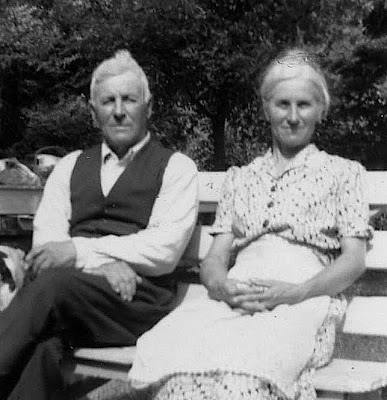
Left: Vern and Mina Ducklow, circa 1946.


I have but one single memory of my Grandpa Vern.  In spring of 1961, Grandpa came for a visit at our home in Hudson.  This was a time when Dad (Vic Ducklow) was working as a mail sorter for the Post Office in St. Paul and decided that Hudson was reasonable commute to work, so he and Mom bought a home there in 1960.   We lived at 604 Sixth Street.  Our white two-story house was modest and fit right in with the other homes of the neighborhood.  There were lots of other young families that made the city block feel like a community.

A half block down from our house was a small corner grocery located on Sixth and Vine.  Besides carrying an assortment of milk, eggs, bread and other staples, the store had a vast (at least in my very young eyes) selection of penny candy.  On the day of his visit, Grandpa Vern loaded me into my red Radio Flyer wagon with a long black handle, and pulled me a half-block along the uneven cement sidewalk down to the corner store.  Upon arriving, I jumped out of the wagon and we walked in the cramped building.  Grandpa then gave me a nickel to buy five pieces of candy!  Tootsie rolls were my favorite (and still are) and so I picked out five and handed the nickel over to the clerk.  Grandpa bought some candy for himself too.  I stuffed four of the five pieces of candy into my pockets, and keep one out to eat on the wagon ride back home. I was happy to have been given a long ride to the store and eating sweets too!

As I visualize Grandpa on that day, I recall him being very tall and thin. I can’t recall his voice, but his demeanor struck me as being soft-spoken and kind, and perhaps a bit frail.  I don’t recall Grandma Mina being there that day, but she could have simply been in our house and my memory was all about Grandpa pulling me in my wagon and buying me sweets.  I wish I could recall more about him, but I was just too young (I think I was only about 27 months old). 

Grandpa Vern died in July of 1961, from complications of a broken hip.  He was 81.  Five weeks prior he had fell during a middle-of-the-night trip to urinate outside.  He slipped on the dew laden grass and lay helpless through the night until Grandma Mina awoke in the morning finding him.  Gradually, Grandpa’s body began to shut down, unable to recover from the trauma of the fall.  With today’s medicine, death from a broken-hip is uncommon, but fifty years ago an elderly person falling resulting in a broken hip was often a death sentence. Such was the case for Grandpa Vern.

 ❧

Footnote: Vern never learned to drive a car.  When he needed to travel around Spring Valley, he took a horse or walked.  The range of horse was all the distance he needed to go in most cases.  Mr. Rex Pearce, a friend of Vern’s had the need to conduct business in the Twin Cities.  He would on occasion take Grandpa Vern along, drop him off at our home in Hudson in the morning, and upon his return, pick him up and drive back to Spring Valley in the evening.


Footnote: I’m not sure how long this store remained a grocery. Not too many years after we moved from Hudson, it had been converted into a boutique flower shop.  

Footnote:  It’s hard to imagine today, but Grandpa and Grandma's home did not have running water and no inside toilet.  Water came from a manual pump located a few feet from the front porch.  Their toilet was an outhouse situated a few dozen yards away from their home, dug into the side hill.  There a worn path from between the house and the privy.  Not having inside facilities was an inconvenience in the spring, summer and fall, but must have been a real trial each winter! 


Footnote: The story of Vern's fall and Vern's rides to Hudson learned from a discussion with Pearl Ducklow on November 25, 2010.


Footnote: Pedigree back to Thomas & Elizabeth Ducklow:  Vern > George > Thomas Ducklow


The Fruit Bowl Bet

(Its Not About Football)

[Updated October 19, 2009]

My Grandpa Vernie Ducklow passed away in 1961 at age 81 years.  He lived a full life, most of it around Spring Valley, Wisconsin.  It has been a bit difficult to find many stories about him, but here is one that is known:

In early 1907 Vernie and his pal Gideon Arneson were walking along the planks that formed the boardwalk [see footnote] of main street in Spring Valley. As they walked they came upon the display window of the Foss-Armstrong and Johns Hardware Company [see footnote].  This store was known for its hardware offerings, but it was also stocked with other merchandise too, including housewares that ranged from spatulas to flower vases.  Vernie and Gideon both paused and took notice of a very decorative and expensive fruit bowl prominently displayed in the store’s front window.  The beautiful glass bowl was handcrafted from translucent pink and white glass.  It had scalloped edges with gracefully curved sides and featured a hand-painted design of blue berries with gold-leaf flourishes.  The bowl sat ensconced in a four-legged base that connected to an ornate handle. The handle and base were masterfully crafted by a silversmith.  It was a piece of art and very stylish for that  period.


The Ornate Fruit Bowl 

Retailed at Foss-Armstrong-Johns Hardware Company, Spring Valley, Wisconsin

Manufactured circa 1906


Now it seems a bit odd that two single young men in there mid-twenties would stop and admire this beautiful fruit bowl.  But they did as you see that both were courting their future wives.  Neither one could afford to buy the bowl that day but each agreed that it would make a wonderful gift for one of their sweethearts.  Without means to purchase the bowl one would have thought this is where the conversation would have ended.  But apparently there was a bit of a rivalry between them regarding who would convince their respective girlfriend to marry them first.  One thing lead to another and soon a bet was on.  Right then and there they agreed that the first to marry would receive the bowl as a wedding gift from the other.


Vernon and Mina Ducklow Circa 1948


A few months later, on July 25, 1907, Vernie married Mina Bowen in Denver, Colorado (Vern was working at the machine shop for railroad at the time).  Eventually the newlyweds returned to Spring Valley and received many congratulations and well wishes along with a number of wedding gifts including one from Vernie’s pal Gideon.  Gideon had not forgotten about the bet he made several months prior.  He honored Vernie and Mina with the gift of the handcrafted fruit bowl with the silver handle that he had purchased at the Foss-Armstorng-Johns store.

Vernie and Mina cherished this wedding gift during their 54 years of marriage. The ornate bowl was likely one of the most valuable household possession that they ever owned, especially after losing much during the Great Depression.  Gideon Arneson did go on to marry too.  Federal Census records show that by 1910 he was wed a woman named Parmilia (Millie).  Like Vernie and Mina, Gideon and Millie spent their lives in and around Spring Valley and no doubt were friends with Vern and Mina through the years.


 The Rest of the Story

In 1961 Vernie passed away and by 1964 Mina became unable to care for herself and so she entered a nursing home.  In preparing for this, many of Mina’s household possessions went to her children including the ornate fruit bowl.  It was given to Mina’s daughter Audrey.  She and her husband Hank Thompson lived in Phoenix and so the bowl traveled from Spring Valley to Arizona in about 1964.   Sadly, just three years later Audrey passed away.  After Audrey’s death, the bowl had little meaning to Hank, and as Hank and Audrey had no children, he kindly gifted the bowl to Audrey's brother Vic.  Hank brought the bowl back to Wisconsin from Arizona in about 1970 during a vacation, but without the silver base.  He had not realized the bowl had a holder. For a while it was thought that the base was lost, but Hank later discovered it back in his home in Phoenix and then mailed it to Wisconsin.  Unfortunately, a slight bend of the handled occurred in shipping, but was expertly corrected by Vic. Without knowing the bend occurred, one could never tell.

Today the 100 plus year-old bowl with silver base and handle rests in an honored place in the Ducklow family.  It seems a bit of a miracle that this beautiful bowl has not been broken after all these years.  It is also a wonderful to know of how it came into the family so many years ago.

 ❧

Source: Pearl Neiderhauser Ducklow told this story to Jeff Ducklow October 11, 2009.

Footnote: Pedigree: Vernon George Ducklow > George Ducklow > Thomas and Elizabeth Ducklow

Footnote: Pearl Ducklow told this story referring to the hardware store as the Olsen-Wolf store.  This was the name of this mercantile when she was a young girl (1930s).  However, at the time of this story (1906-1907) it was owned by Foss who also owned a hardware store in Ellsworth, along with partners Armstrong and Daniel Boone Johns.  See page 419 of Doug Blegen's "Spring Valley Early Days" published in 1995.  The Foss-Armstrong-Johns hardware store location is now the present day location of the Spring Valley Drug Store; on the corner of 1st Street and McKay Avenue.

Footnote: Spring Valley did not have concrete sidewalks until the summer of 1910.  Up until then the walks were either dirt paths or elevated wood planks forming a boardwalk.  See page 209 of Doug Blegen's "Spring Valley Early Days."