Showing posts with label John and Elizabeth Hanson. Show all posts
The Mystery of Maria Jane Dukelow
[Published March 29, 2011] [Updated March 30, 2011]


There has always been somewhat of a puzzle over the exact number of children born to our ancestral grandparents, Thomas and Elizabeth Ducklow / Dukelow.  The number has appeared to 13 by accounts of from many different sources.  But there has be a bit of lingering doubt if this number should be 14 due to a mysterious baptismal record for a baby named Maria Jane Dukelow -- whose parents were Thomas and Elizabeth Dukelow.  This record of baptism is from St. Paul’s Episcopal church, the same church were Thomas and Elizabeth and family were very active members. Despite the name being linked to Thomas and Elizabeth, this record seemed spurious, as no other references to Maria Jane have been discovered.  It also puts the child count beyond 13 which conflicts with other reliable information on the children of the family.   The name Maria Jane Dukelow is only known to be documented by this one church record. It has been tempting to disregard the record, but the source is so authoritative that to do so would be a compromise of research integrity. So this one record of Thomas and Elizabeth's Maria Jane has remained a mystery.


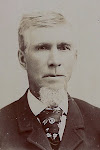
Left: Elizabeth Ducklow Hanson and John Hanson. Circa 1922.  Picture from the Ruth Sandmann Photo Collection. Elizabeth is about age 66 here.


Examining the records again today, I think I have unknotted the issue.  

The ninth child of Thomas and Elizabeth Ducklow was Elizabeth Ducklow born on October 10, 1856. This Elizabeth grew into adulthood and went on to marry John Hanson.  Together, John and Elizabeth farmed and raised their family of eight children near Poskin in Barron County, Wisconsin.  It seems very straightforward to concluded that the Elizabeth Ducklow Hanson was named after her mother, Elizabeth Nicholson Ducklow. This reasoning is logical and traditional, but now appears to be not quite accurate. I believe that Elizabeth Ducklow Hanson was originally named Maria Jane Ducklow.

Why would her name change? How did Maria Jane become to be known as Elizabeth?

Maria Jane had a slightly older sister named Elizabeth.  About four months after Maria Jane’s birth, older sister Elizabeth died in February of 1857. Elizabeth was about 18 months old.  In the grief of losing a loved baby, the family decided to rename four-month old Maria Jane to honor baby Elizabeth.  Naming a new baby after a sibling who died as an infant was quite common during this period.  In fact Thomas and Elizabeth had done this once before when infant son George died and they named their next son George (see footnote).  No doubt the short gap in age (maybe 14 months) between the first Elizabeth and re-named Maria Jane blurred the line of identity of the two infants and eased the grieving process. So Maria Jane became Elizabeth. What seems to be unique about this case is that is s a re-naming of a several-weeks-old baby after its sibling died in contrast to the naming a new-born.

While there is not absolute proof that this name change occurred, the known facts support the argument well.  Here are five reasons why I believe this to be true:

(1) There is a baptism record for a Maria Jane Dukelow born to Thomas and Elizabeth Dukelow (not Ducklow – see footnote) recorded in the St. Paul Episcopal church records.

(2) Beyond this one baptism record, there is no further mention of a Maria Jane in other known records for Thomas and Elizabeth’s family, including a Federal Census taken in 1860.

(3) No baptism record can be located for the second baby Elizabeth born to Thomas and Elizabeth.  However all of Thomas and Elizabeth's other children that were born in Wisconsin have baptism records at St. Pauls, including the first baby Elizabeth baptized 11 November 1855.

(4) The baptism date of Maria Jane is Nov 9, 1856.  Second baby Elizabeth's birthday is October 10th 1856, a one-month period typical of the time elapse between a birth and baptism.

(5) The obituary for Thomas Ducklow (Sr.) states that he and Elizabeth had 13 children. Accounting for Maria Jane would require 14 children.  By recognizing the Maria Jane and second baby Elizabeth are the same person restores the count to 13.

You may wonder that when Thomas and Elizabeth changed Maria Jane's name to Elizabeth did they have to change Maria Jane’s birth certificate?  The short answer is no.  Recall that Wisconsin became a state in 1848 and had very a limited government regulation in 1856.  It was not until 1907 that the state required births to be registered. So in this case there was no birth certificate to be concerned with.  The lack of red tape meant there was no real barrier to renaming a child, especially a child that was only four months old.  It was simply a matter of calling the baby a new name.  The church may have frowned a bit on this, but no doubt there are many other examples of children being baptized with one name, but called by something completely different in day-to-day life.

So with this explanation, the mystery of the name Maria Jane Dukelow / Ducklow is solved. Elizabeth Ducklow Hanson was actually, at least according to St. Paul's church’s records, Maria Jane Ducklow Hanson.

 ❧

Footnotes:

(1) Elizabeth’s older brother, George was the second George of the family.  Infant George was born September 1849 and died October 14, 1850.  The next child born to Thomas and Elizabeth was also named George.  He was born 10 August 1851.


(2) As documented elsewhere in this blog, the spelling of the surname Ducklow took several forms, especially before the 1860s.  Dukelow was a common spelling, and was used by several of Thomas’ half-brothers. It is possible that another Thomas Dukelow lived in the Ashippun area and had a child named Maria Jane and attended church at St. Paul’s Episcopal Church.  While possible, it seems unlikely. 

(3) Of all the records viewed, Elizabeth Ducklow Hanson name never appears with a middle name.  A possible future discovery of her middle name of being Maria or Jane or Maria Jane would certainly add  credibility to this story.


(4) In a bit of ironic near miss of overlapping names, my wife's name is Jane Marie Ducklow.

Dewayne Hanson Pays Ultimate Sacrifice

Against Hitler and the Nazi Army

[Published September 28, 2009]


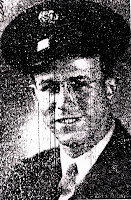
Dewayne Charles Hanson, age 25, was killed during military operations against the German Army on January 20th, 1945.  He was a Staff Sergeant in 94th Division of the 301st Infantry for the U.S. Army. Dewayne’s sacrifice, along with sacrifices of thousands of other Allied and Russian troops ensured that Adolph Hitler’s xenophobic vision of the world came to an end.


In the last months of 1944 Hitler and leaders of the German military knew that they were losing the war.  Allied forces had already recaptured France and Belgium and had begun pushing into Germany.  The Third Reich’s goal of dominating Europe and beyond had been reduced to defending the homeland and avoiding surrender.  And so the Germans began a new strategy against the Allied Forces.  The Nazi's plan was to get the Allies into a non-winnable military positiona stalemateand then negotiate a peace treaty.  They needed to get out of waging a two-front war: Besides fighting the Allies in parts of Belgium, Luxembourg, France and Germany, Hitler's forces were also in a massive battle with the Red Army along the so-called “Eastern” front on the German-Soviet boarder.  By gaining a stalemate and subsequent peace on the “Western” front, the Germans could apply all of their resources against the Russians in the east.  A one-front war would also help Hitler by giving his engineering teams additional time to design and build more advanced weapons, including completion of an atomic bomb.


Sgt. Hanson's career with the U.S. Army began on December 12, 1942. He trained at Camp Phillips in Kansas and then at Camp McCain in Mississippi.  After completing training he was transferred to England in August of 1944 where he spent two weeks.  About mid-August his infantry company  arrived on the eastern shores of France, near St. Nazaire.  This was about two months after D-Day, when the first wave of Allied Forces attacked the Germans on Utah beach.  Sgt. Hanson's company moved across France pushing any German pockets of resistant east.  In three months time they had entered western Germany.  This occurred about January 1st, 1945.


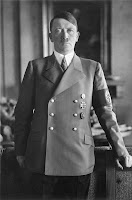
Adolph Hitler

Source: Wikipedia Commons 


The implementation of the Nazi’s new stalemate strategy resulted in what is widely known as the “Battle of the Bulge.” This battle was the last major offensive by the Germans.  It began in mid-December of 1944 and continued over Christmas and for most of January 1945.  The name “Battle of the Bulge” was coined by newspapers accounts of the battles and the position of the front line.  At this point in the war, maps showing the location of the front was more-or-less a north-south line, except where the Germans had launched this new offensive.  The newly drawn maps showed a “bulge” of German controlled territory towards the west.


The goal of the German offensive was to divide the Allies’ front line and then out-flank them.  Hitler believed that if the front were split the Allied commanders would realize that the war would become protracted and they would then move towards negotiating a peace treaty.  War analysts say that Hitler’s plan was flawed and his own military leaders thought this plan dubious, but Hitler demanded it be carried-out.  The initial surprise attack by the Nazi Army occurred December 16th in the steep slopes of the Ardennes forests in Belgium and Luxembourg. This military operation was one of the largest and bloodiest battles of World War II: Germany counted over 91,000 men killed, wounded, or captured.  Allied Forces, mostly Americans, reported 19,246 men killed; 47,500 men wounded, and 23,000 men captured or missing.


On January 7th, Sgt. Dewayne Hanson and all of the 94th Infantry Division, was positioned in an area called Saar-Moselle Triangle.  This is a mountainous area in far western Germany not far from the French-German-Beligum boarder.  Their infantry company was able to stop the Germans from advancing and began having success in forcing units into retreat. Between January 7th and January 20th, there were numerous battles in this area with heavy causalities by both sides, but the Germans continued to be pushed further eastward.  Then on January 20th Dewayne’s unit engaged in an attack on the Nazi Army in the City of Orscholz.  During this battle, the Americans incurred very heavy casualties.  A loss of nearly two companies of men (200-500 soldiers) was reported in just one day.  This battle was likely were Dewayne’s sacrifice to our country was made.


So many American soldiers died in 1944 and early 1945 that it was impossible for all the bodies to be returned to the United States for burial.  To accommodate the dead, several American Cemeteries were established in Western Europe, including one in Luxembourg City, Luxembourg.  A cemetery of 50 acres became the final resting place for 5,076 American service members, including General George Patton and our cousin, Sgt. Dewayne Charles Hanson.

Dewayne was awarded the Purple Heart posthumously.  This battle ribbon is given in the name of the President of the United States to members of the military who were wounded or killed or died after being wounded while serving our nation.

Purple Heart Ribbon: George Washington Profile inside


By the first of February of 1945 the Western front was roughly in the position it was before the start of the Battle of the Bulge.  The German’s plan of breaking through and dividing the Allies failed.  And with that failure came the failure of the entire strategy of gaining a peace-treaty with the Allies.  During the months of February, March and April most of the German Army had been killed, captured or surrendered.  On April 30, 1945 a desperate and resigned Hitler committed suicide.  A week later, on May 8th, , the entire world celebrated VE  DayVictory in Europe.


 May we always remember those who served and gave their lives defending our freedoms.

 ❧

Dewayne was the son of Charles and Emma Hanson and the grandson of John and Elizabeth Ducklow Hanson.

Sources:

(1) Memorial Services for Sgt Dewayne Hanson, Barron County News, February 9, 1945

(2) World War II and Korean Conflict Veterans Interred Overseas – Ancestry.com

(3) American Battle Monuments Commission http://www.abmc.gov/search/wwii_list.php

U.S. Army Military History http://www.history.army.mil/html/forcestruc/cbtchron/cc/094id.htm

(4) Battle of the Bulge - http://en.wikipedia.org/wiki/Battle_of_the_Bulge

(5) World War II in Europe - http://www.historyplace.com/worldwar2/timeline/ww2time.htm


Footnote: Dewayne was survived by his wife Muriel Bussewitz.  They apparently had no children. Prior to joining the Army he was a milk tester for the Turtle Lake Cooperative Creamery.

Biography of Fred J. Hanson
Son of John Hanson and Elizabeth Ducklow Hanson
[Published January 25, 2009]

The biography of Fred J Hanson that follows is excerpted from page 480 of a book titled History of Barron Co., Wisconsin published by H. C. Cooper, Jr. & Co. in 1922. This tome is another example of a self-congratulating local "history" filled dotted with complementary language outlining the life and virtues of a local area's many esteemed citizens. This history book's volume of pages are a primarily a collection of paid autobiographies of some residents the Barron County area with some some information about the attractive features of the county that make it a great place to carve-out a living. A separate post in this blog containing biography of Charles Ducklow discusses the economic nature of this types of local biographical books.

Fred J Hanson was the first born of Elizabeth Ducklow and John Hanson. Elizabeth was Thomas and Elizabeth Ducklow's tenth child. Elizabeth and John Hanson moved from the Oconomowoc area to Clinton Township in Barron County about three years after the were wed. both Fred and his sister Nellie came to Barron County as very young children (ages three and one, respectively).


Fred J. Hanson, an active farmer of section 11, Clinton Township, was born at Oconomowoc, Waukesha County, Wisconsin, Dec. 2, 1883, the son of John and Elizabeth (Ducklow) Hanson, natives of Ashland County, Wisconsin [see footnote], of Norwegian and Irish descent. John Hanson is a farmer and carpenter. He came to Clinton Township in 1886, and secured 80 acres in section 2, to which he later added 80 more, making a good place of 160 acres, which he developed, and where he carried on general farming until his retirement. In the family there were eight children. Fred J. is a Clinton farmer. Nellie is the wife of Charles Blair, of Clinton Township. Charles farms on the old homestead, Lila is in Rice Lake. Theodore J. lives in Poskin, this county. Gordon, Clarence and an unnamed infant are dead. Fred J. was brought to this township when he was three years old, and was here reared and educated. He thoroughly learned farming and carpentering from his father, and remained at home until after he was 27 years old, helping with the farm work and following his trade throughout the surrounding country. In the fall of 1911 he bought 80 acres in section 11, Clinton Township. He has developed this into a good place, and here he successfully carries on general farming, stock raising and dairying, breeding good cows, horses, sheep and swine. He is one of the enterprising young men of the community, modern in his methods, liberal in his ideas, and held in the highest liking and esteem by all who know him. Mr. Hanson was married at Dallas, this county, Sept. 27, 1911, to Hilma Thollander, who was born in Clinton Township on Feb. 18, 1890, the daughter of Charles J. and Signe Thollander, natives respectively of Sweden and Norway, and early settlers of Clinton Township, who now live at Hudson, this state. There were two other children in the family: Teekla and Emma, who died at the age of two years. Mr. and Mrs. Hanson have two bright children. Budd J. was born Oct. 28, 1915, and Glen C. was born April 8, 1917.

Footnote: This biography states that John and Elizabeth are natives of Ashland, Wisconsin. This is the only reference the author has ever found stating that Elizabeth or John are from Ashland. If they were from Ashland, they had lived there for only a very short time. Both Elizabeth and John were born in Dodge and and Jefferson Counties in southern Wisconsin, were wed there and had their first two children born there.

Footnote: The original publication occurred in 1922. Its copyright expired on or before 1997 . The book is now in the public domain.